

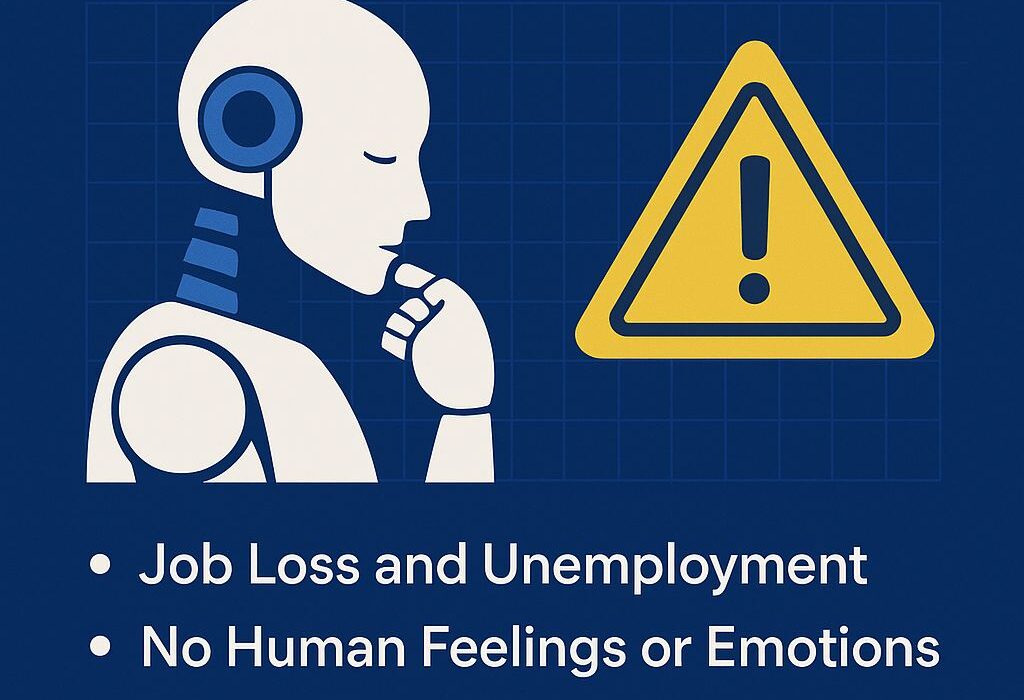
Discover the major disadvantages of Artificial Intelligence, including job loss, ethical concerns, data privacy risks, and emotional limitations. Learn how AI impacts our daily lives and what challenges lie ahead. Artificial Intelligence (AI) has completely changed the way we live, work, and think. From voice assistants like Siri to self-driving cars and smart robots, AI is shaping the future faster than ever. But while AI brings convenience and efficiency, it also comes with serious drawbacks that we cannot ignore. Below are the main disadvantages of Artificial Intelligence and why we should use it carefully.
1. Job Loss and Unemployment
One of the biggest downsides of AI is that it’s slowly replacing human workers. Machines and robots can now do many tasks faster, cheaper, and more accurately than people. This is great for companies, but not for employees. Jobs in factories, transportation, and even customer service are being taken over by automation, leading to job loss and unemployment. People will need to learn new skills to stay relevant in an AI-powered world.
Do Visit: Top Advantages of Artificial Intelligence (AI) in Daily Life
2. No Human Feelings or Emotions
AI can think, but it can’t feel. It doesn’t understand emotions, compassion, or creativity like humans do. This makes AI unsuitable for roles that need empathy—like counseling, teaching, or healthcare. Depending too much on AI could make our world feel less human and more robotic.
3. Expensive to Build and Maintain
Developing smart AI systems is not cheap. They require powerful computers, skilled programmers, and tons of data. Maintaining and updating these systems can also cost a lot of money. For small businesses or developing countries, the cost of using AI can be a huge challenge.
Do Visit: Open Doors Scholarship 2026 Russia (Fully Funded)
4. Privacy and Security Problems
AI systems depend on data lot of it. But collecting and storing personal data can be risky. Hackers can break into systems and misuse this information. Also, tools like facial recognition raise serious privacy concerns, as they can be used to track people without consent.
5. Ethical and Bias Issues
AI systems learn from the data they are trained on. If that data has any bias, the AI will make unfair or wrong decisions. This has already happened in areas like hiring and law enforcement. Plus, when an AI system makes a mistake, who’s responsible? These ethical questions still don’t have clear answers.
Conclusion
Artificial Intelligence is an amazing technology, but it is not perfect. It can replace jobs, invade privacy, and make biased decisions if not handled properly. To make the most of AI, we must use it responsibly and ethically. After all, technology should make life better, not replace what makes us human.
Also Check: The Dark Side of Tech: E-Waste & How to Fight It
For more info, Please Visit Our Official Sites: Facebook, Twitter, and Instagram.